From answers to outcomes
The best support agents see the question, solve the problem behind it, and stay long enough to know whether it worked.
Imagine an advertiser writing to support on Friday afternoon:
“Why did my campaign stop getting clicks?”
A promotion starts Monday. Every hour matters.The account shows a destination error. The campaign sends people to a landing page that was unavailable when the ad platform last checked it.
A good answer can explain the policy and tell the advertiser how to request another review. That is useful. It may also leave the advertiser with a quiet campaign on Monday morning.
The question was about clicks. The problem is broader: the advertiser needs eligible ads, a working destination, and enough time to reach customers during the promotion. The support case is a symptom of that larger objective.
This difference gives us a practical way to think about support agents. They can Answer a question, Resolve the problem behind it, or Pursue the customer’s outcome over time.
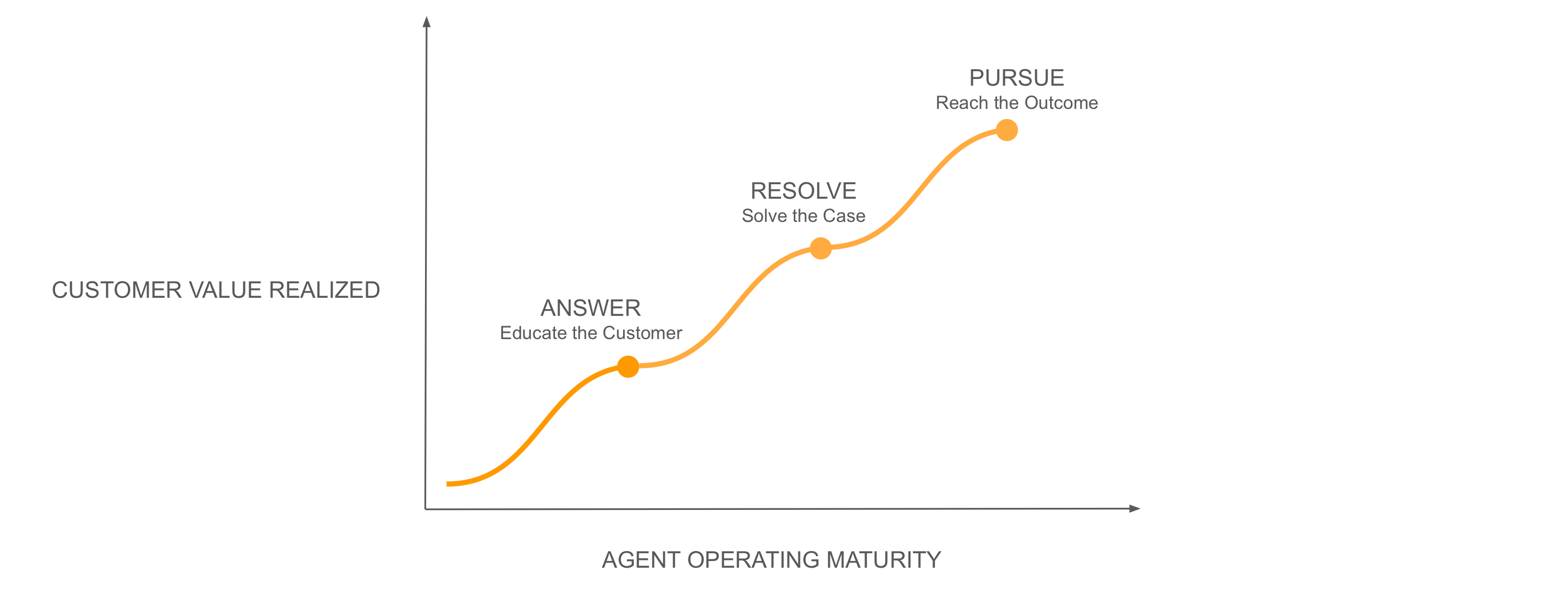
Answer: help the customer understand
At the Answer level, the agent explains why delivery stopped. It checks the current policy and account status, distinguishes what it knows from what it is inferring, and gives the advertiser a relevant next step.
For this case, the agent might say that the campaign is not serving because the destination was unavailable during review. It can point to the affected ad, explain how destination checks work, and describe how to resubmit once the page is healthy.
This is where retrieval-augmented generation, or RAG, earns its keep. For policy-sensitive support, general model knowledge is an unreliable source of truth. The answer must be grounded in current, authoritative, permissioned sources. A retrieval layer interprets the query, searches approved sources, filters them by the advertiser’s permissions and market, ranks the most relevant passages, and assembles the context the model uses to answer.
A dependable RAG system has to solve more than search. It needs document freshness, access controls, source citations, conflict handling, and a clear response when evidence is missing. Evaluation should separate retrieval quality from generation quality. Did the system find the right policy and account evidence? Then, did it explain that evidence correctly?
The advertiser leaves better informed. The burden of diagnosis and action still sits with them.
Resolve: solve the problem behind the question
Resolve requires a different depth of troubleshooting. The agent cannot stop at the first visible error. It needs to understand what the advertiser is trying to accomplish and determine what is actually blocking it.
It checks whether the landing page works now, whether the error affects one ad or the whole campaign, whether another policy issue would block delivery next, and whether a new review can be requested safely. It also notices that the advertiser’s deadline is Monday.
If the destination is healthy and the agent has permission, it submits the affected ad for review and records what it did. It does not change the budget, bidding, creative, or targeting simply because those controls are available. Those choices belong to the advertiser.
Underneath that work, Resolve turns frontline expertise into executable skills. A skill is more than a longer prompt. It captures when a troubleshooting procedure applies, which evidence must be gathered, the order of checks, the exceptions that change the path, the action the agent may take, and the conditions that require a person.
For the destination-error skill, the agent may call one API to inspect ad status, another to test the landing page, and a third to request review. Each tool needs a narrow contract: valid inputs, authentication, permission checks, expected side effects, and a structured result the agent can verify. Write actions also need protection against duplicate calls, along with a recovery path when an API times out after the action may already have occurred.
The best frontline specialists already carry much of this logic in their heads. Building Resolve means extracting that judgment, making it inspectable, and pairing it with tools the agent can use safely.
The original query was “Why did my campaign stop getting clicks?” The resolved case is “The eligible ad is back in review with the known blocker removed.” Answer explains the symptom. Resolve works on the cause.
Pursue: stay with the objective
A review submission is progress, not an outcome. The campaign could be approved and still fail to deliver. The destination could break again. Review could take longer than the promotion can tolerate.
At the Pursue level, the agent keeps responsibility for the open objective. It remembers the Monday deadline, checks the review result, re-tests the destination if the error returns, and revises the plan when conditions change. If the case needs a specialist, it transfers the history, evidence, and next checkpoint instead of making the advertiser start again.
Technically, Pursue requires an agent that can run beyond one conversation. It operates in a loop: observe the current state, choose the next safe action, act, verify what changed, and decide when to check again. Some loops run for minutes. This one may run through the weekend.
That demands durable state outside the model’s context window. The system has to preserve the advertiser’s objective, deadline, completed actions, evidence, permissions, open risks, and next checkpoint. A scheduler or event trigger wakes the agent when review status changes or a timer expires. Budgets limit how long and how often it can run. Stop conditions define success, failure, and the point where human judgment is required.
Long-horizon agents also need protection from drift. Before every consequential step, the agent should re-read the current state and confirm that the action still serves the original objective. The loop is valuable because conditions change. That is also what makes it harder to control.
The agent closes the work only after it observes healthy delivery or makes a safe, explicit handoff. It knows the difference between completing an action and achieving the customer’s goal.
The troubleshooting gets deeper
| Answer | Resolve | Pursue | |
|---|---|---|---|
| Question being solved | Why did clicks stop? | What is preventing this campaign from serving? | What must happen for the promotion to reach customers? |
| What the agent inspects | Policy and current status | Account evidence, scope of impact, root cause, permissions, and next blockers | Changing state, deadlines, dependencies, recovery paths, and observed results |
| What the agent does | Explains and guides | Diagnoses, acts within authority, and verifies the action | Checks back, adapts, recovers, and hands off with context when needed |
| Technical foundation | Permission-aware RAG with citations and freshness controls | Expert-authored skills, tool calls, API contracts, and action verification | Durable state, plan-act-observe loops, event triggers, budgets, and stop conditions |
| Evidence of success | The explanation is correct and useful | The blocker is removed and the case moves forward | Healthy delivery is observed, or responsibility is safely transferred |
| Unit of work | Question | Case | Customer journey |
| Learning, across every level | Use outcomes, failures, and expert corrections to improve the knowledge, tools, permissions, memory, and recovery paths the next case depends on. | ||
Learning is the horizontal
Only after these responsibilities are clear does learning become useful. Learning is not a fourth rung after Pursue. It runs across all three.
- Answer learns when a confusing explanation, stale source, missed retrieval, or missing policy is corrected.
- Resolve learns when an expert changes the skill, diagnosis, tool contract, permission boundary, or escalation path.
- Pursue learns when a case stalls, relapses, or closes too early and the loop gains a better state field, checkpoint, stop condition, or recovery plan.
A real learning loop changes something the next case can use. It updates a knowledge source, a troubleshooting skill, a tool contract, a memory field, or an evaluation scenario. A folder full of transcripts is only storage.
Why the distinction matters
Most support metrics make the first conversation easy to see. Outcomes are harder. They unfold across systems and time, and they often depend on events outside the agent’s control.
That makes it tempting to declare success when an answer is sent or an action is completed. But the customer does not experience a tool call. The advertiser experiences whether the campaign reaches customers while the promotion still matters.
This is where private operating knowledge becomes valuable. The strongest support organizations know which question reveals the real problem, which action is safe, which warning predicts a relapse, and what evidence is strong enough to close the work. As Sarah Guo argues in “The Untrainable,” much of that judgment is earned inside the work and written down over time.
A simple test for any support agent
Take one customer query and ask three questions:
- Answer: Did the customer get a grounded explanation they can understand?
- Resolve: Did the agent find and act on the problem behind the query?
- Pursue: Did someone remain responsible until the customer’s outcome was observed or safely handed off?
Then ask what the system learned that will make the next journey better.
The move from Answer to Resolve to Pursue is a widening promise. First, help the customer understand. Then, help them move forward. Finally, stay with the work long enough to know whether it mattered.